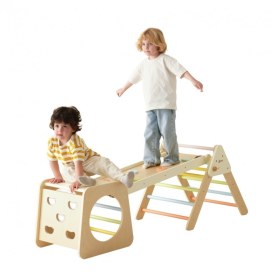
Climbing triangles for children and other balance equipment give children the chance to move, explore and build their own play. Climbing, balancing, crawling, rocking and sliding offer playful challenges through which children can practise body awareness, coordination, gross motor skills and confidence in movement. However, choosing the right product depends on more than just how many functions it has.
Before buying, consider the child’s age and abilities, the size of the space, the type of product, its stability, any load limit and adult supervision. Products inspired by Montessori and Pikler principles can support independent play, but not every product in the range can automatically be described as an official Montessori or Pikler product. Suitability for kindergarten should also be assessed separately, based on the specific product information and the setting’s safety procedures.
In this guide, we compare climbing triangles, climbing arches, balance boards, balance stones and multi-functional climbing frames for children. This will help you understand when a simpler solution is enough, when a combination set may be a sensible choice, and what to check before choosing climbing and balance equipment for your home or group room.
This article focuses on the Climbing and Balance category and explores the range in terms of intended use, suitability and practical criteria for comparison.
How do you choose climbing and balance equipment?
The first question is not “which product has the most activities?”, but “what kind of play does the child really need, and what can they use comfortably at their current ability level?”. Some children may enjoy a balance path that can be easily rearranged, others are more interested in climbing, while others like being able to move from one activity to another. Choose a product based on the child’s current stage of development, not only on what you expect for the future.
Age and abilities
Always check the recommended age range for the specific product and compare it with the child’s actual movement skills. Age alone does not show whether a child can climb, descend, balance or stop their movement. An age-appropriate challenge is one the child can try independently, while an adult can step in quickly if needed.
For example, the range includes a wooden climbing set with a triangle ladder and reversible slide board, designed for children aged 18–48 months. The wooden balance play set for children with double-sided balance boards is described as suitable for children aged 3–8. These examples show why a single age recommendation cannot be applied to all climbing equipment. For some products, it is especially important to compare the recommended age with the child’s skills and the instructions for use.
Product type and main purpose of play
- A climbing triangle or Pikler climbing triangle focuses on climbing, planning movements and imaginative play. It can be a simple base that a child uses in different ways.
- A climbing arch adds an arched climbing or rocking option. In some sets, it can be used with other parts, while in others it can be used on its own.
- A balance board is suitable when you want to practise balance and create different movement activities without a tall climbing frame.
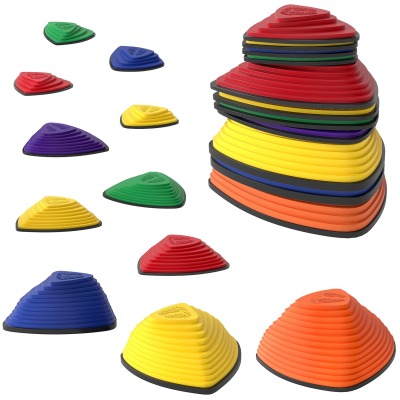
- Balance stones for children allow you to build a rearrangeable course. The distance between the stones, their direction and their order change how the activity is set up.
- A combination climbing frame can bring together climbing, sliding, a climbing wall, rocking, a tunnel or other activities. A variety of features is useful only if the space and the child’s skills allow them to be used sensibly.
Space, dimensions and storage
Before ordering, measure the space where the climbing equipment will be placed and leave enough clear space around it for movement. Also consider where the child will move after sliding down or leaving the course. A tight space between furniture, a wall or sharp corners does not give the child enough room to play, even if the product itself physically fits there.
Check the dimensions, whether it folds and the recommended place of use on the product page. A foldable option can be practical in a smaller children’s room if it is easy to put away after play and position correctly before use. It is also worth considering whether you want a permanent climbing corner or equipment that can be brought out from time to time. You can also explore additional storage options in the Storage category, but the area around the climbing equipment must remain clear during play.
Surface, stability and load
For climbing and balance play, it is important that the equipment stands stably during use and that the surrounding area has a suitable surface. Check any features confirmed in the product description for each product individually: for example, the balance stones set has anti-slip strips and a textured surface, but these features should not automatically be attributed to other products.
If a maximum load is specified for the product, compare it with the intended use. The maximum load of the wooden balance play set for children is 50 kg, and the same limit is given for the set with a triangle ladder and reversible slide board. Do not assume a load limit for other products; check the details on the specific product page. Always follow the manufacturer’s installation, use and supervision instructions too.
Differences between home and kindergarten
When choosing for home, you can take into account the skills and play routines of one or two children, as well as the layout of the space. In a kindergarten, you need to consider a larger number of users, different ages and skill levels, visibility in the group room, cleaning, storage and how an adult can supervise the activity. A solution that suits one child may not be suitable for shared use by a group.
Climbing equipment for kindergarten should be chosen only after checking the details of the specific product and the institution’s internal safety rules. Check that the place of use, children’s ages, load, layout and supervision arrangements are compatible. The product name “Montessori” or “Pikler” does not replace a risk assessment or, in itself, prove that the product is suitable for every childcare setting.
Climbing and Balance
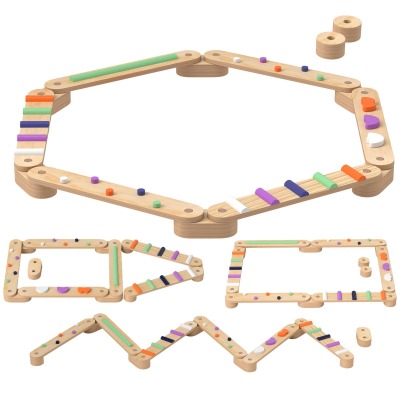
Climbing and Balance can form one continuous game for a child: first they move across a course, then climb higher, slide down or turn the structure into a den. The wooden balance play set for children with double-sided balance boards can be used to create courses in different shapes with six boards and eight bases. The product description highlights both a smooth and a textured play surface, as well as indoor and outdoor use for children aged 3–8; the maximum load is 50 kg. This set is an example of a solution where a child does not have to follow the same course every time, but can redesign it together with an adult.
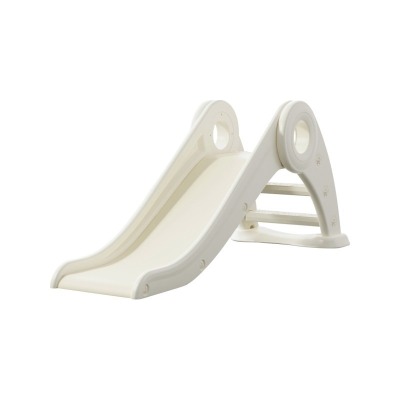
The Kaimala children’s slide, white, shifts the activity from climbing to sliding. According to the description, the slide and its ladder help children practise balance and strengthen their muscles; the product has no sharp edges, corners or protrusions, and is lightweight and foldable. For any specific use, however, follow the product instructions and ensure there is enough space around the ladder, sides and landing area.
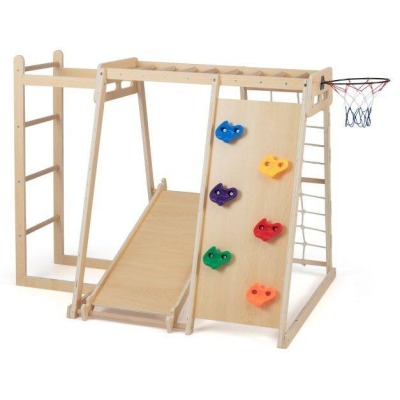
If a child enjoys variety, you could consider the 6-in-1 indoor climbing frame playground, whose description mentions a slide, climbing bars, adjustable climbing ramps, ladders and a basketball hoop. It is a multifunctional indoor option with a sturdy wooden frame; the description states that the structure is designed for up to three energetic children. Before choosing it for a kindergarten or shared use, check the full product instructions, space requirements and the institution’s safety arrangements alongside this claim.
A simpler choice and a versatile one are not always opposites. For some children, a balance course is a good starting point because it can be built low and at a calm pace. Another child may find it more natural to climb a triangle or use a climbing arch. When choosing climbing and balance play for home, consider which activity appeals to your child most and whether the product can also be used when an adult does not want to plan the whole game.
Climbing triangle, climbing arch and combined solution
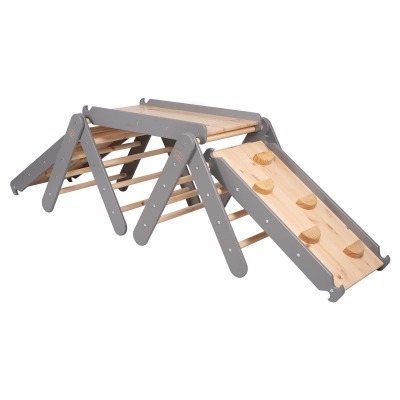
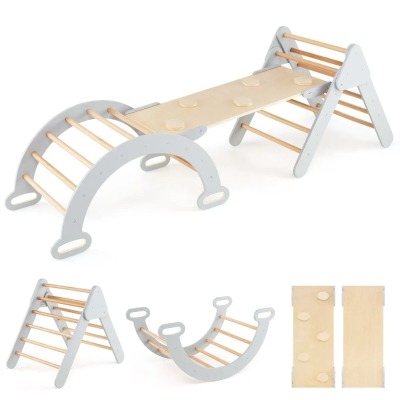
A 4-in-1 Climbing Triangle with Climbing Arch, Ladder and Slide shows how one set can support different kinds of play. According to the description, the pieces can be used separately or together. The ramp has two different sides for varied climbing and sliding experiences, and the climbing arch can be turned over and used as a rocker. With a set like this, it is worth planning before purchase where the different pieces will go during play and which activities are suitable for the child.
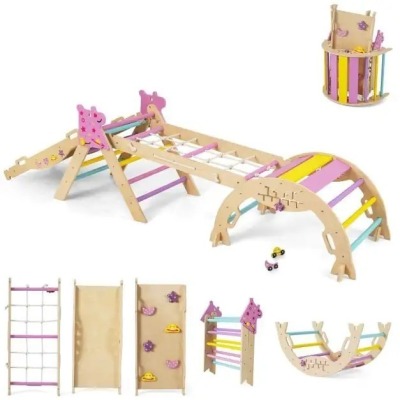
The Foldable Pink Climbing Triangle Play Set with Tunnel is designed to offer toddlers a variety of activities. According to the description, it includes 8–9 activities, such as a rocker, climbing ramp, triangular tent, climbing triangle, balance bridge, semicircular bridge, rocking arch and crawling tunnel. When there are many pieces, it is especially important to avoid making the play area too complicated all at once: an adult can start with one or two activities and add others gradually.
The 11-Piece Multicoloured Balance Stones Set is a different example. The triangular stones have anti-slip strips and a textured surface, can be stacked and can be used indoors and outdoors. By changing how the stones are arranged, you can create a balance course where the child steps, pauses, turns or moves on to the next element. Here too, assess the stability of the arrangement and the floor space before use rather than assuming all arrangements are equally suitable.
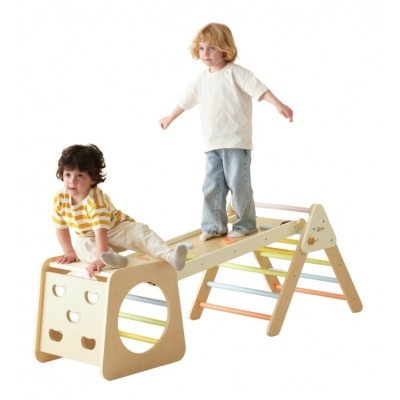
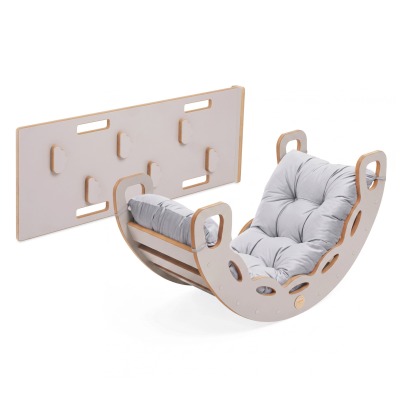
For products with a wider range of activities, a simple distinction can help with the purchase decision: are you looking for one main activity, a reconfigurable course or a small indoor climbing playground? From a Montessori perspective, it is important that the child can choose what to try, act as independently as possible and encounter a manageable challenge. This does not mean that every product labelled Montessori is an official educational aid, or that all Pikler climbing triangles have the same design.
The Montessori approach focuses on a child’s active participation and a simple, thoughtfully prepared environment. A Pikler climbing triangle, by contrast, is a more specific type of climbing equipment associated with movement, climbing and child-led play. The terms may appear side by side in product descriptions, but they should not automatically be treated as synonyms or as a guarantee of quality or safety.
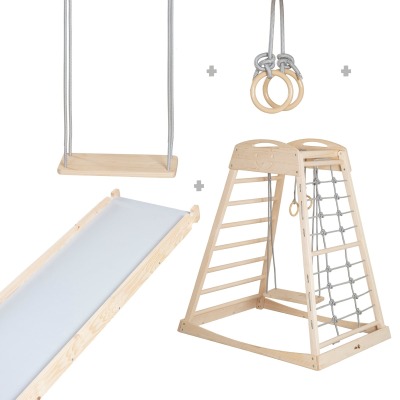
According to the description, the Montessori Indoor Climbing Tower in the range includes a climbing net, bars, a replaceable solid-wood swing, gymnastic rings, and a 2-in-1 slide and climbing board. This is an example of a product suitable from 24 months, but users should still consider the child’s abilities, the available space and the instructions. The Wooden Montessori Triangle 5-in-1 is also designed to support active play, motor skills, balance and coordination, but its exact conditions of use should be checked on the product page.
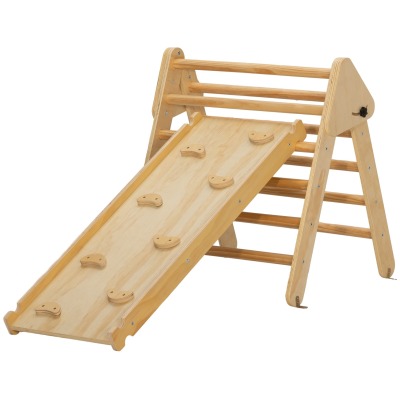
The Small 4-in-1 Baby Rocker combines a rocker base, a reversible climbing wall and slide, and a soft dark grey Velvet cushion. The description presents it for everyday play, relaxation and supporting natural motor development. The Wooden Kids’ Climbing Set with Triangular Ladder and Reversible Slide Board is foldable, for indoor use and has an adjustable slide-board angle; its recommended age is 18–48 months and its maximum load is 50 kg.
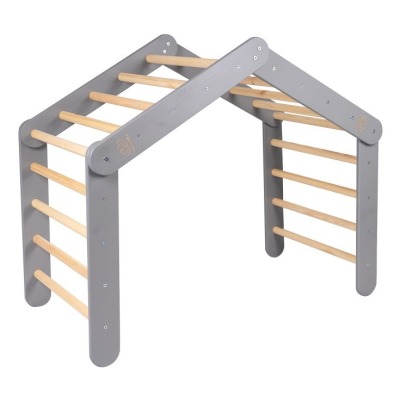
The Large Grey Pikler Climbing Triangle can offer more imaginative play around one main activity: according to the product description, a small blanket can be placed over the ladder to make a den. The Climbing Triangle with Slide and Climbing Wall combines climbing and sliding. For both, choose according to the child’s abilities and the available space, rather than assuming that a larger set or one with more pieces is always better.
Which option suits which kind of play?
If your main aim is to practise stepping, pausing and controlling body position, a balance board or balance stones set may be suitable. Balance Stones for Kids offer more ways to rearrange a course, while a balance board may be easier to understand as a single play item. The Wooden Balance Play Set lets you change the course using six double-sided boards and eight bases, and choose between a smooth or textured surface.
A climbing triangle is a sensible choice if the child enjoys climbing up, moving across a climbing ladder or creating an imaginative play setting with the equipment. A combined climbing set is a better fit if you want to bring climbing, sliding, swinging or crawling together in the same play area. For example, the pieces in a 4-in-1 set can be used together or separately, while an indoor climbing frame with six activities offers several activities in sequence.
- Balance board or balance stones: a flexible balance course and rearrangeable play; check that the surface, arrangement and stability are suitable.
- Climbing triangle: climbing and imaginative play; check the child’s abilities, available space and the product’s age information.
- Set with climbing arch: adds an arch or rocking to climbing; check how the pieces are used and where they will go.
- Climbing triangle with slide: combines climbing and sliding; allow space for the descent too.
- Multifunctional climbing frame for kids: many activities in one place; check the space, number of users, instructions and adult visibility.
The number of functions is not an independent indicator of quality. In a smaller children’s room, a foldable or simpler option may be more practical than a large playground, while a frame with several activities may seem appealing in a group room but require a more thorough assessment of safety and supervision.
How to organise climbing and balance play?
Start calmly and let the child choose the activity. An adult’s role need not be to demonstrate every movement, but to create a suitable environment, follow the child’s pace and offer help when needed. For example, it is in keeping with Montessori principles when a child can choose whether to move across a balance course, climb from a lower point or use climbing equipment in imaginative play.
Four Simple Play Ideas
- Completing a balance path: position balance boards or stepping stones so that your child can move from one point to another. You can change the path later, but check each new layout before use.
- Low obstacle course: combine walking, stopping, turning around and crawling. A tunnel, bridge or ramp from a foldable climbing triangle set can add a new stage to play, if they suit your child’s abilities and the space available.
- Climbing and sliding: combine a climbing triangle or ladder with a slide board, and agree that your child will take turns using it. Keep the landing area clear.
- Imaginative play: A Pikler climbing triangle or climbing arch can become a bridge, mountain, den entrance or part of a game. This gives your child the opportunity to plan their own activities.
At home, before play, check that the equipment is correctly positioned, does not wobble unexpectedly and has no loose toys, sharp edges or furniture around it that your child could bump into while moving. Use a suitable floor surface and follow the manufacturer’s instructions. Supervision must be active: an adult must be able to see the activity and reach your child quickly if needed.
In a kindergarten, you also need to assess how the activity fits into the group’s daily schedule and the available space. Consider whether several children may use it at once, how turns will be managed, the different skill levels of the children, and arrangements for cleaning and storage. A climbing frame suitable for a smaller group may not automatically be suitable for a large group. Before introducing it, check the institution’s safety rules and the specific product’s age, dimensions and load information.
Checklist before each use
- Is the product in a sufficiently spacious and visible location?
- Are the frame, board, stones, ramp or other parts stable?
- Are the floor surface and any landing area clear?
- Is your child using the equipment within their abilities and in accordance with the product instructions?
- Can an adult supervise the play and intervene if needed?
If you’d like to add a softer landing or play area to active play, also take a look at play mats and puzzle mats. They do not change the rules for using climbing equipment, but may help you plan the whole play area; choose what is suitable for the specific situation and product details.
Common mistakes when buying climbing equipment
- Choosing the product with the most features. More activities also mean more space is needed and more situations for an adult to supervise. Solution: choose features your child can and genuinely wants to use.
- Checking the age range and load limit too late. Products in the same category can have very different usage specifications. Solution: check the specific product’s age and load information before buying; do not assume details from one product apply to others.
- Placing the equipment in a space that is too small. Fitting the equipment into a room does not mean there will be enough room to move and land safely. Solution: measure both the product’s position and the surrounding area.
- Treating the Montessori or Pikler name as a guarantee. These terms describe an approach or an association with a product group, not an automatic certification, proof of safety or suitability for every child. Solution: always check the specific product’s features and instructions.
- Assuming that home use translates directly to a kindergarten setting. More children use the equipment in a kindergarten, and their abilities may differ. Solution: check the institution’s safety rules, group-room layout, supervision arrangements and product usage limits.
- Treating supervision as a substitute for the product. An adult’s presence does not make a space that is too small, incorrect positioning or failure to follow instructions safe. Solution: combine stable positioning, a clear surrounding area, a suitable surface, following the instructions and active supervision.
Frequently asked questions
What age is a climbing triangle suitable for?
It depends on the specific model and your child’s movement skills. For example, one triangle ladder and reversible slide board set in our selection is designed for children aged 18–48 months, while a Montessori indoor climbing tower is for children from 24 months. Always check the age recommendation on the product page and consider your child’s readiness.
Is a climbing triangle a Montessori toy?
A climbing triangle can support independent, active play that is in keeping with the Montessori approach, but not all climbing triangles can be called official Montessori equipment. The product name alone does not prove certification or a specific educational status.
What is the difference between a Pikler climbing triangle and a Montessori climbing set?
A Pikler climbing triangle is a specific type of climbing equipment that supports child-led movement and climbing. Montessori climbing set can be a broader term for several active play solutions. The terms may overlap, but they should not automatically be considered the same.
Which is better: a balance board, balance stones or a climbing frame?
The right choice depends on the main activity. A balance board is suited to simpler balance play, balance stones can be rearranged to create a path, and a climbing frame often combines several activities. Compare your child’s abilities, the space, supervision and the specific product details.
Is a climbing triangle suitable for a smaller children’s room?
It may be suitable if the product dimensions, clear movement area and storage options work together. Foldability can be practical in a smaller room, but even foldable equipment must be set up in a spacious, visible place for play.
Is a climbing set suitable for a kindergarten?
Some solutions may be suitable, but this cannot be decided based only on the product category or use at home. Check the specific product’s age and load information, space requirements and instructions, as well as the kindergarten’s own safety rules. Also consider several children and different skill levels.
What should you check before using climbing equipment?
Make sure the equipment is positioned stably, the surrounding area is clear, the floor is suitable and any landing area is unobstructed. Your child should use the product in a way that is manageable for them, and an adult must be able to supervise and intervene if needed.
How to choose a multifunctional set?
First, write down the activity that matters most to your child: climbing, balancing, crawling, swinging or sliding. Then check whether all the desired functions fit in the space, suit your child’s abilities and can be used according to the manufacturer’s instructions. More functions do not automatically make it a better choice.
Summary
The best climbing solution depends on your child’s abilities and age, the available space and the kind of play you want to encourage. A climbing triangle is a good basis for climbing and imaginative play; a balance board or stepping stones can be used to create a balance course; and a combined children’s climbing frame brings several activities together in one play environment.
Before buying, always check the specific product’s age range, dimensions, weight limit, intended place of use and instructions. When choosing for a kindergarten, add the establishment’s safety rules, higher number of users, cleaning, storage and supervision requirements to your list of checks for home use. Explore the selection in the Climbing and Balance category and compare the exact details on the product pages to find a suitable solution that your child can manage.