Kids' Sofas help create a dedicated spot in a child's room where they can sit, look at a book, play or simply relax. A suitable model should not only be eye-catching, but should also fit the room, the child's usual needs and the family's care routine. Before buying, consider whether the sofa will mainly be used for quiet sitting, shared by several children or used to create a movable play and relaxation space.
Choosing a kids' sofa depends above all on the available floor space, a seat height that suits the child, the sofa's width, construction and how easy the cover is to care for. In this guide, we compare compact sofas with a fixed shape, kids' modular sofas, soft foam options and a model with a wooden frame. This makes it easier to decide whether to choose a flexible modular system from the range of kids' sofas, simpler seating furniture or an alternative better suited to a specific use.
It's important to look at each product individually. Don't assume that all models in the category are the same size, have the same cover or age recommendation, or offer the same uses. Always check the exact dimensions, number of parts, care instructions and construction on the individual product page.
This article focuses on the Kids' Sofas category and explores the range in terms of needs, suitability and practical comparison criteria.
How to choose a kids' sofa?
A kids' sofa for a child's room should meet a real need: give the child their own seat, support quiet activities and fit the room while leaving enough space to move around. Start by deciding where the sofa will go. Measure the available area and, in addition to the furniture's own dimensions, consider how the child will move to the sofa, sit on it and get up. If it has modules, allow space for possible rearrangements too.
Space, dimensions and seat height
When assessing sofa width, consider whether it will usually be used by one child, two children or an adult sitting together with them. A wider model can be comfortable for reading together, but in a small room a more compact option may leave more space for play. Armrests affect both the seating area and the sofa’s overall width, so check the usable seat width and the furniture’s overall external dimensions separately.
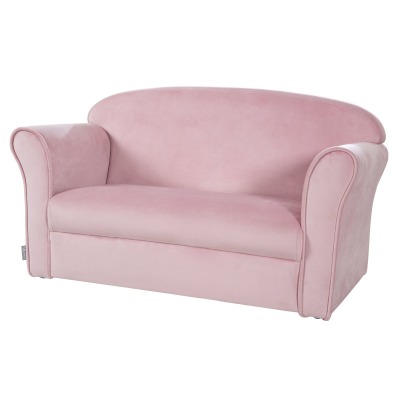
Seat height is important for a child’s everyday independent use. Reaching a seat that is too high can be uncomfortable, but suitability cannot be judged by the number alone: the child’s height, leg position and the sofa’s overall depth also matter. For example, the description of the Lil Sofa with armrests specifies a seat height of 22 cm, a width of 78 cm and suitability for children from 18 months. These details provide a specific starting point, but the specifications for other models should be checked separately.
Fixed-shape or rearrangeable design?
A fixed-shape kids’ sofa makes sense if you already know where it will go and what it will mainly be used for. Its shape is easier to plan around, and the child has a clear spot for reading or sitting. A modular sofa is a better fit if you want to change the layout to suit an activity or how the room is being used. The number of modules and configuration options vary between models, so check which parts are included and how the manufacturer says they can be used.
Modular flexibility does not automatically mean that every modular kids’ sofa is suitable for a small room or active climbing. Some models are described as being for rearranging and relaxing, while others specifically mention crawling, climbing or play configurations. Your choice should be based on the specific product, the size of the room and how often you want to move the furniture around.
Construction and softness
A foam filling specified in the product description indicates a soft seating option, whose shape and feel, and how well it suits the child’s activities, are worth considering. A model with a wooden frame has a different construction and may feel more like a substantial piece of furniture. Neither option is automatically better in every situation: the features that matter for a quiet reading corner may differ from those of a playful, rearrangeable set.
Softness also needs a practical assessment. If the child will mainly use the sofa for reading and relaxing, a comfortable seat and a shape that suits the child are important. If the furniture is in a play area, check whether the product description allows for specific activities, such as rearranging the modules or climbing. It cannot be assumed that all soft kids’ sofas are suitable as play sets.
Cover material and care
The material of a kids’ sofa affects its feel, appearance and care routine. Options may include models with velvet, slimcord or bouclé-style covers. Whether a texture feels pleasant is partly a matter of preference, but from a practical point of view, always check the care instructions given by the manufacturer for the specific product.
A removable or machine-washable cover can be important for everyday use, but this should not be assumed for the whole category. For example, the description of a modular climbing foam play set mentions removable, machine-washable covers. For other models, check whether the cover is removable, how it should be cleaned and what care restrictions the manufacturer specifies.
Age and actual use
A kids’ sofa for a young child should be chosen according to the child’s actual use, height and ability to move around the room. If the product description includes an age recommendation, use it as a starting point, but do not apply one model’s specifications to the entire category. For example, the description of a grey kids’ sofa with a wooden frame gives a recommended age range of 3–15 years, while the Lil Sofa is for use from 18 months.
For a baby or very young child, the sofa should be used at an adult’s discretion and under adult supervision. No general category description replaces the instructions for a specific product or an assessment of the child’s abilities. If you mainly need a place to sit, consider seating comfort and dimensions; if you want a play area, look for a product whose description clearly specifies that use.
Kids' Sofas
A kids’ sofa can be much more than a small seat in a child’s room. It gives the child a place of their own to listen to a story, draw, play make-believe or take a quiet break between games. The first question to ask might be: do you need a ready-shaped piece of furniture or an option that can be changed to suit the room and activity?
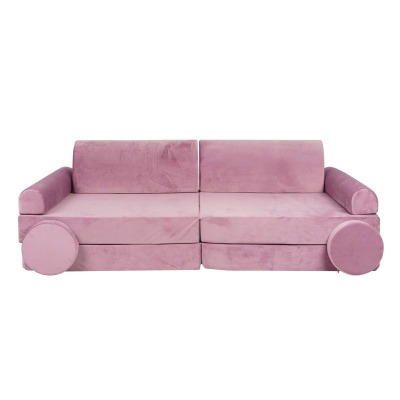
If you want a clear, easy-to-place model, consider more structured options such as Kids’ Sofa Aesthetic Cube or Kids’ Premium Sofa with Velvet Cover. Both descriptions specify soft foam and use for playing and relaxing. The Aesthetic Cube is also described as having a soft-touch cover, while the Premium sofa has a soft velvet surface. These are different starting points worth comparing against the child’s preferences and how the room is used overall.
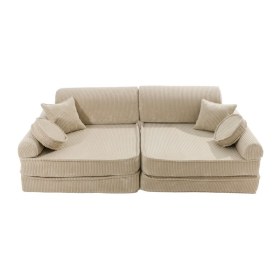
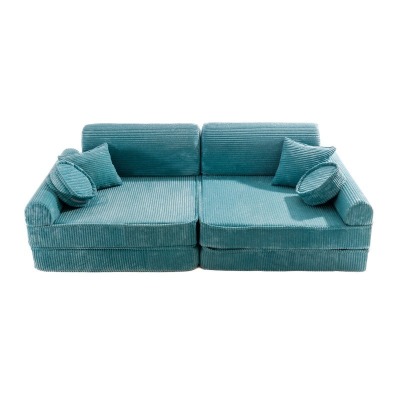
If you need an arrangement that can be changed, modular sofas are worth considering. The Kids’ Modular Sofa Aesthetic in cream and the Kids’ Modular Sofa Aesthetic in turquoise are described as velvet models designed to give children a place to relax, read or nap. The colour can help the furniture suit the look of the room, but when making your final decision, it is more important to check the specific model’s dimensions, shape and care information.
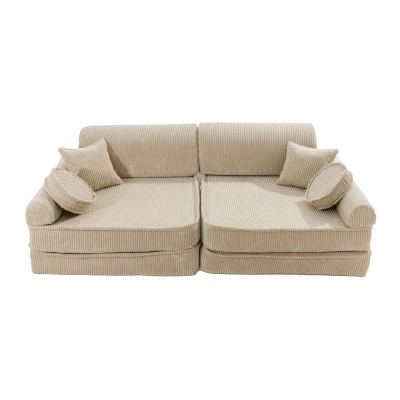
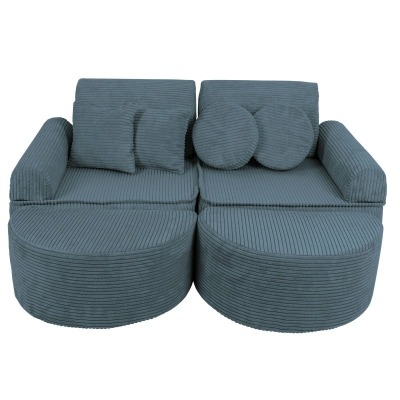
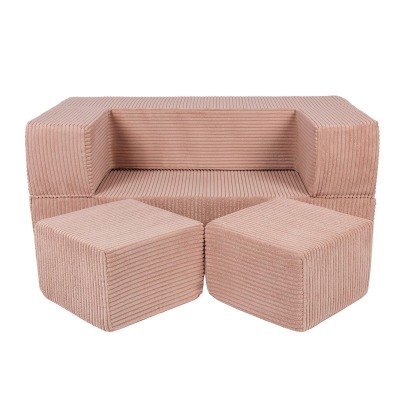
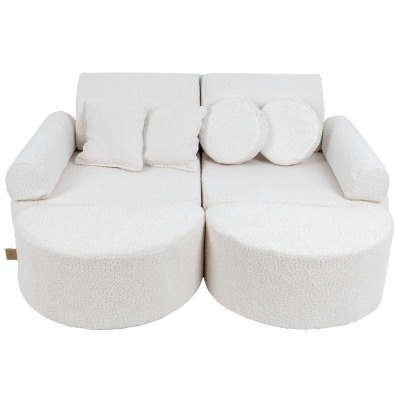
The advantage of modular furniture becomes most apparent when the way a room is used changes. According to their product descriptions, Max Aesthetic Turquoise Kids' Modular Sofa and Max Boucle White Kids' Modular Sofa each consist of 14 pieces and can be arranged in several ways. The description also mentions the option of fully taking the sofa apart to create a comfortable bed. This does not mean every modular sofa offers the same option, so always check the number of pieces and permitted configurations on the product page.
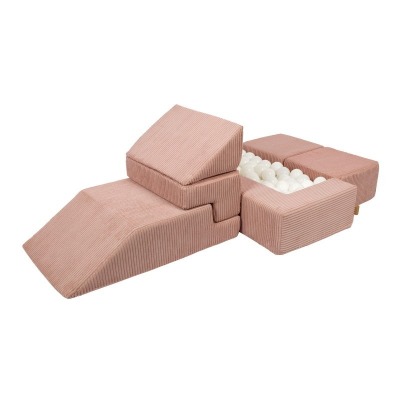
The Aesthetic Soft Modular Set Sofa in powder pink takes a different approach. Its description lists various configurations, including a sofa, ball pit and full-size play area. This may suit a family looking to combine seating and play, but before buying, consider where all the modules will be stored and how much floor space the different arrangements require.
If playful use of modular sets is important to you, you can also compare the categories ball pits and soft blocks or foam play blocks. These do not automatically replace a kids' sofa, but they can help you decide whether you are primarily looking for seating or a flexible soft play module solution.
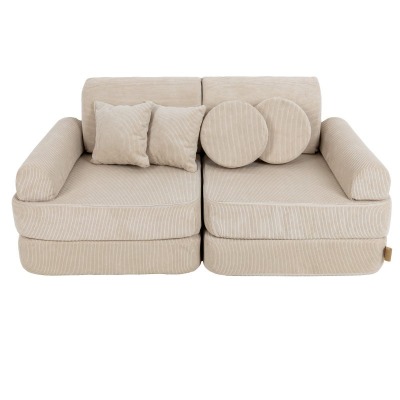
A third option to consider is construction and care. According to its description, the Plus Slimcord Cream Kids' Modular Sofa consists of 12 pieces that can be freely arranged. This may be a good choice if you want one set that can be used in different configurations, but when planning the room, allow for the entire set rather than just the dimensions of one finished sofa shape.
The modular kids' sofa with machine-washable covers is described as a solution that can be arranged for climbing, crawling or relaxing. Its pieces are filled with high-density foam, and the covers are removable and machine washable. These features set it apart from ordinary seating, but you should still follow the specific product's use and care instructions and not treat all kids' sofas as climbing equipment.
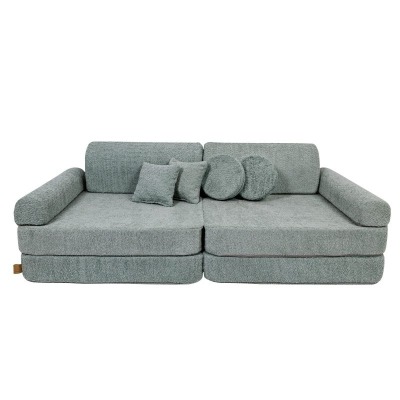
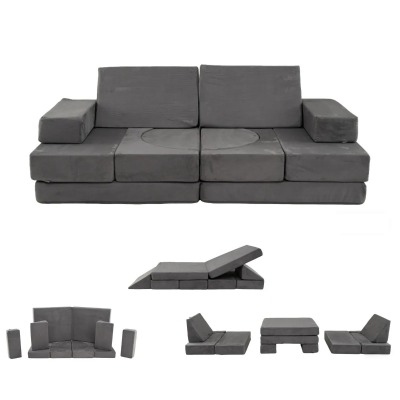
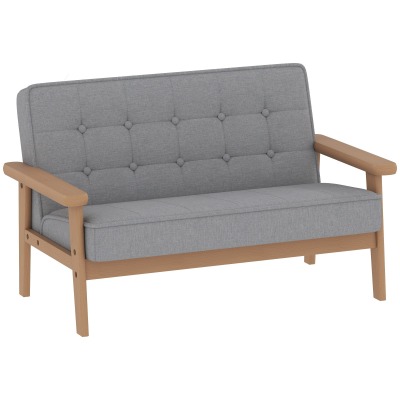
If you prefer a model with a sturdier frame, the grey upholstered kids' sofa with a velvet-like finish is a two-seater on a wooden frame. Its description mentions high-density foam, armrests, a sturdy wooden frame and suitability for children aged 3–15. This is a good example of why it is worth comparing construction separately: a sofa with a wooden frame is not the same type of solution as a set of soft modules.
If you are looking for a smaller seat of its own, kids' armchairs may also be suitable. For several children or a wider seating area, take a look at the full kids' sofa category, as models differ in dimensions, seat height, construction and covers.
Comparing kids' sofas: which option suits your needs?
If you mainly need furniture for reading and relaxing, start with a soft kids' sofa in a fixed shape or a model with a wooden frame. The descriptions of the Aesthetic Cube and Premium Sofa highlight soft foam filling and a comfortable place to play and relax. The grey sofa with a wooden frame differs in construction: its description mentions a two-seater shape, armrests, a wooden frame and high-density foam.
A kids' modular sofa makes sense if you want to change the arrangement. The Max models are described as having 14 pieces, the Plus Slimcord model has 12 pieces, and the Aesthetic Soft Modular Set can be configured as a sofa, ball pit or play area. The number of modules and the uses described provide a clear basis for comparison, but do not by themselves show how well a particular set will fit in your room.
If care is important, check the cover separately. Velvet, slimcord and bouclé-like surfaces differ in texture and appearance, but you cannot draw a general conclusion about ease of cleaning from these alone. Machine washability and removability are confirmed only in the description of a specific product, such as the play set with machine-washable covers. The Lil Sofa is described as having a soft velvet fabric cover, a seat height of 22 cm, a width of 78 cm and armrests, so it may be a practical starting point if you are looking for a compact kids' sofa with armrests.
A practical checklist before buying
Before ordering a kids' sofa, measure the available floor space and mark where the furniture will go. For a modular sofa, do not plan around just one arrangement: consider whether the pieces will fit in an alternative configuration and whether there will be room for your child to move around them. If the sofa is next to a play area, leave enough free space for other activities too, not just seating.
Use the following checklist to review the product page:
- check the sofa's overall dimensions, width, depth and height;
- check the seat height if it is listed in the product details;
- for modular sofas, check the number of pieces and the configurations described;
- check whether the product has a fixed frame, foam filling or another construction described;
- check the cover type and whether it is removable or machine washable;
- check the recommended age if the manufacturer has provided one;
- read the care instructions before ordering, not only after the furniture arrives.
You can create a peaceful reading nook around the sofa by placing a light nearby and leaving enough clear space in front of the seat. For a more playful set, consider when it will be used for sitting and when for play. Kids' bean bags can offer a different kind of soft seating, while ottomans and bean bags may work as a smaller extra seat or a flexible addition to the room. If you are looking for a ball pit, you can also compare the ball pit category, but it is a solution with a different primary purpose.
When choosing a colour and texture, consider the rest of the room's furnishings, but do not make these your only deciding criteria. Cream, turquoise, pink, white, grey, fresh mint or powder pink may suit different interiors, but for a child, dimensions, seat height, shape and ease of care are just as important for everyday use.
Common mistakes when buying a kids’ sofa
- Choosing a sofa based only on its colour. A beautiful shade does not tell you whether the sofa will fit in the room or suit your child’s height and intended use. Solution: measure the space and check the seat height and overall dimensions on the product page.
- Not thinking through the space needed for the modules. A modular sofa can be rearranged, but all the pieces need space. Solution: plan at least two ways to use it and consider where the remaining pieces will go.
- Assuming every cover is washable. A velvet, slimcord or bouclé-style surface does not in itself tell you how to clean it. Solution: check whether the cover is removable or machine washable, and consult the care instructions for the specific model.
- Assuming all soft sofas are suitable for climbing. Some product descriptions specifically mention climbing or crawling, while others describe the sofa as suitable for sitting and resting. Solution: follow the product’s usage description and do not apply one model’s features to the entire category.
- Not considering the child’s age and intended use. The same sofa may not be equally suitable for a toddler, preschooler and older child. Solution: compare the recommended age, dimensions and whether the child will use the furniture for sitting quietly or more active play.
- Applying one product’s details to others. The number of pieces, dimensions or wooden frame of one model do not describe the whole category. Solution: check each product page separately and compare only confirmed details.
Frequently asked questions
How to choose a kids’ sofa to suit the size of your room?
Before buying, measure the available floor space and allow for room to move around the sofa. For a modular sofa, also plan alternative layouts, as the actual space required depends on how the pieces are arranged.
What is the difference between a modular sofa and a regular kids’ sofa?
A sofa with a fixed shape has one clear layout, while the pieces of a modular sofa can be rearranged within the options described. The number of modules and how they can be used depend on the specific product, so check the product page to see which configurations are possible.
What does soft foam filling mean for a kids’ sofa?
It means that foam is listed in the product description as the filling or main component. For example, the descriptions for the Aesthetic Cube and Premium Sofa specify soft foam. Check the details for the specific model for information on comfort, dimensions and care.
Is a kids’ sofa suitable for playing or just for sitting?
It depends on the product. The descriptions for some modular sets mention climbing, crawling or creating a play area, while other models are described primarily for sitting, reading and resting. Do not assume it is suitable for play unless the product description confirms this.
What information should I check about caring for the cover?
Check whether the cover is removable, whether it can be machine washed and what care instructions the manufacturer provides. Velvet, slimcord and bouclé-style surfaces may feel different, but the material name alone does not determine how to clean them.
What should I consider about a kids’ sofa’s seat height and armrests?
The seat height should suit the child’s height and ability to use it independently. Armrests can help define the seating space, but they take up some of the sofa’s width. For example, the Lil Sofa description lists a seat height of 22 cm, armrests and an overall width of 78 cm.
When might a kids’ sofa with a wooden frame be a suitable choice?
A model with a wooden frame may suit you if you are looking for a two-seater sofa with a fixed structure rather than a set of soft modules that can be freely rearranged. The grey model’s description mentions a sturdy wooden frame, armrests and high-density foam.
How to choose a kids’ sofa for several children?
Look at the sofa’s overall width and actual seating area, and consider whether the children will use it at the same time. The Lil Sofa description says that two children can sit comfortably on the 78 cm-wide sofa, but check the relevant product page separately for other models.
Which dimensions and features should I check before placing an order?
Check the height, width, depth, seat height, number of pieces, cover type, construction, recommended age and care instructions. For modular sofas, also check whether the planned layout will fit in the room and whether the product description supports the intended use.
Summary
Choosing a suitable kids’ sofa starts with defining the space and how your child will actually use it. If you need a compact seat with a fixed shape, check the dimensions, seat height and armrests. If you want flexibility, compare the number of modules and configuration options. A model with a wooden frame differs in construction from soft foam options, and for more playful use, rely only on the description of the specific product.
Before buying, always check the exact dimensions, cover, care information, construction, recommended age and what is included in the set. Compare suitable models in the kids’ sofa category and open the product page to make your decision based on confirmed details, not just the colour or general impression.