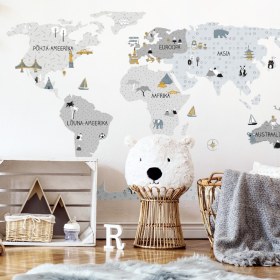
A World Map for Kids can be both an eye-catching decorative feature and an everyday learning aid in a child's room. An Estonian-language world map wall sticker makes it natural to talk about continents, oceans, cardinal directions and the landmarks shown on the map, because the map is always visible to the child. You can look at it during play, drawing or a conversation together, and use it to start asking questions.
In this guide, we focus on how to choose a world map wall sticker for a child's room. We look separately at the suitability of sizes M and L, the role of colour, where to place the map, and how to make it a meaningful part of learning rather than simply a decoration. By the end of the article, you will be able to assess which Estonian-language world map best suits your available wall space, the overall style of the room and how your child will use it.
In this article, we focus on the World Maps category and look at the selection in terms of intended use, suitability and practical comparison criteria.
How do you choose a world map for a child's room?
Before considering colour or size, think about what you want the map to do. If you want to introduce your child to the world's continents, oceans, cardinal directions and landmarks, place the map where you can look at it together and easily return to it during play. This way, the wall sticker for learning becomes more than just a backdrop: it can be a starting point for conversations and small learning activities.
An Estonian-language map is a practical choice. Your child can hear and repeat the names on the map in Estonian, and adults can explain them without first having to translate foreign-language words. A younger child may start by simply looking at the pictures and locations, while a school-age child can use the map for discussions, searching games and as a visual aid to support schoolwork.
Size M or L?
When choosing between sizes M and L, start with the available wall space, rather than simply wanting the biggest map possible. Size M may be more practical if the wall is limited by furniture, shelves or a window, and you want to leave enough space around the map. Size L needs more clear wall space, but may be a good choice if you want the map to be visible from the other side of the room or to create a dedicated area for looking and learning around it.
Consider the viewing distance too. If your child will mostly look at the map from close up, make sure it is at a comfortable height and that a toy box or table will not block it. If the map is to be a central decorative feature in a larger room, size L can create a stronger visual focal point. Before buying, compare the exact measurements with the information on the product page and mark them out roughly on the wall to assess the proportions.
Colour scheme and the overall look of the room
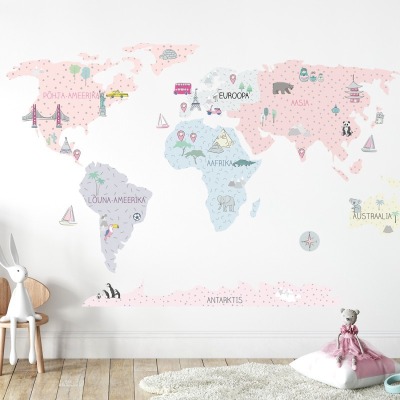
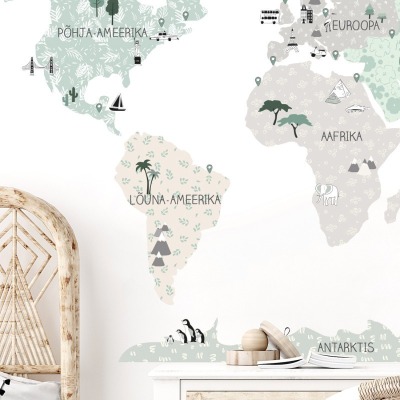
The product description characterises the world maps as having a design in muted Scandinavian-inspired tones. Based on this description, grey and mint are calmer options to consider if the kids' room has a more subdued colour palette or if you want the map to complement the rest of the decor without drawing too much attention.
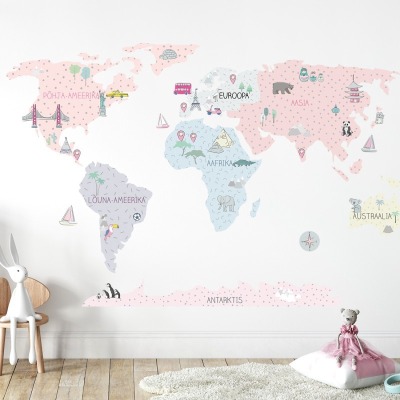
The selection also includes the names spring flower, eco, pink and tropic sand. For these, refer to the specific product photo, product name and the colours in your room rather than assuming the exact appearance from the name. The checklist before making your decision is simple:
- measure the available wall space and check that the map will have enough clearance from the furniture;
- consider where your child will most often look at the map from;
- compare its colour with the walls, textiles and other kids' room decor;
- decide whether the map should be a calm backdrop or the room's main focal point;
- consider how you can use the map in conversations and learning activities together.
World Maps
The World Maps category is ideal for parents looking for an Estonian-language map for a child's room that is both decorative and educational. You can look at the map together with your child from the time they are just getting to know pictures and words. Later, you can talk about where the world's continents and oceans are, how to identify cardinal directions, and which regions or landmarks shown on the map your child recognises.
The first practical difference to consider is size. M options are worth considering when the available wall space is more modest or the map needs to go above a particular piece of furniture. L options need more room and may work better on a wall that can be seen from further away and has enough clear space around the map. So before choosing a colour, decide which size will sit naturally on the wall.
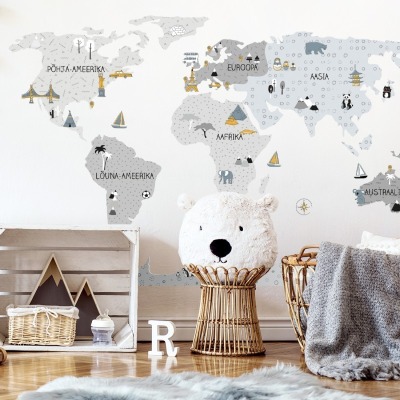
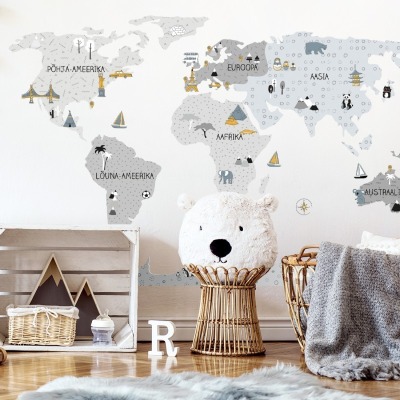
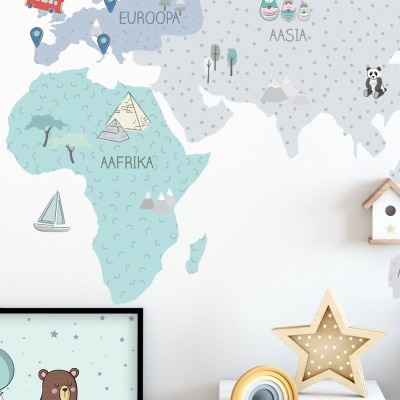
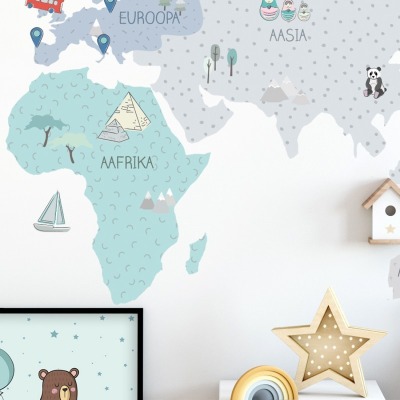
The grey options include Wall Sticker World Map M in Estonian, grey and Wall Sticker World Map L in Estonian, grey. Both are world maps in Estonian in a soft Scandinavian colour palette; the difference is size. M may suit a smaller or divided wall space, while L may suit a space where you want the map to have more visual room and stand out more.
The Wall Sticker World Map L in Estonian, mint is also part of the same size comparison. If the room has a light and calm overall look, mint may be an alternative to grey, but the final choice depends on the wall, textiles and other decor. Look at the product page photo with this in mind: does the map complement the existing colours, or become the room’s main colour focus?
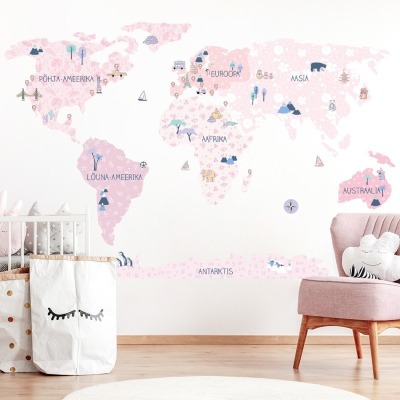
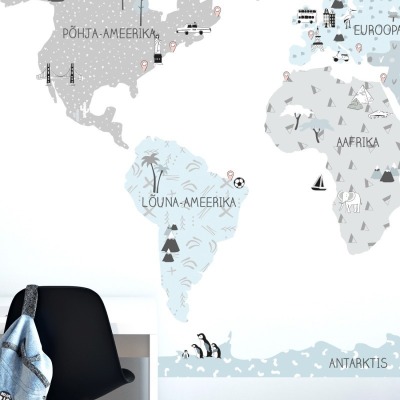
When comparing the World Maps selection, open the pages of products that interest you after viewing the product cards, and check the features listed for each specific model. This keeps the comparison fact-based and helps you choose according to your actual needs.
When comparing the World Maps selection, open the pages of products that interest you after viewing the product cards, and check the features listed for each specific model. This keeps the comparison fact-based and helps you choose according to your actual needs.
Comparing nine world maps in Estonian
If you need a map for a smaller or more divided wall space, look at the M-size options: grey, mint, eco and pink. These include Wall Sticker World Map M in Estonian, grey, Wall Sticker World Map M in Estonian, mint, Wall Sticker World Map M in Estonian, eco and Wall Sticker World Map M in Estonian, pink. In terms of size, these maps belong to the same practical group, leaving more clear wall space around them or allowing you to take existing furniture into account.
If the map needs to be more noticeable on a larger wall or you want to make it the room’s central feature, compare the L-size options. These include Wall Sticker World Map L in Estonian, grey, Wall Sticker World Map L in Estonian, mint, Wall Sticker World Map L in Estonian, spring flower, Wall Sticker World Map L in Estonian, tropic sand and Wall Sticker World Map L in Estonian, pink. L size is not automatically better, as suitability depends on the proportions of the wall and viewing distance.
The grey and mint colour options are described as soft Scandinavian shades. They are sensible starting points for a calmer kids’ room, but always look at the specific product photo too. Spring flower, eco, pink and tropic sand offer more alternatives for those choosing to match the room’s overall colour palette; the product name alone does not describe the entire design.
Three questions help you make a practical choice: will the map fit on the available wall, can your child see it comfortably, and does the colour scheme suit the rest of the room? Once you have considered these points, compare the products in the World Maps category, where you can view more detailed product images and information for the nine selected world maps in Estonian.
How to use a world map and plan before installing it?
Choose a spot for the map where your child often spends time, but where it will not be hidden behind toys, furniture or other decor. A place near the play area encourages spontaneous discovery: your child might ask where a continent or ocean is while playing. Near a learning area, the map can be a visual aid when you talk about geography, travel, directions or a place mentioned in a book.
The height should be based on how your child will actually look at the map. For a younger child, think first about what they can see while standing or playing; for a school-age child, the map could be placed near a desk or reading nook. Do not position it solely at an adult’s eye level, as it may then fall outside your child’s everyday field of vision.
Pre-installation checklist
- Measure the available wall space and compare it with the product details for your chosen M or L size.
- Check that there will be enough room around the map and that furniture will not later be placed in front of it.
- Check the wall surface and read the installation instructions for the specific product.
- Plan the location before placing the sticker on the wall, as it may not be possible to move it after installation in a way permitted by the product information.
- Choose the colour scheme after taking the wall, textiles and other kids’ room decor into account.
Once the map is in place, use it for little games. For example, your child can take turns finding a continent, ocean or compass point; an adult can ask, “Where might north be?” or invite them to choose a place on the map to learn more about together. When looking at landmarks, let your child notice and ask questions for themselves, rather than turning the map into a compulsory lesson.
Common mistakes when choosing a world map
- Choosing by colour alone. A beautiful shade will not solve the problem if the map does not fit on the wall or is hidden behind furniture. Measure the available space and check visibility before choosing the final colour scheme.
- Choosing an L size without considering the room’s proportions. A larger map needs more clear space and may feel too dominant on a small or heavily divided wall. Compare the M and L options based on the room’s actual layout.
- Positioning the map too high or in an awkward spot for your child to see. If your child rarely sees it, there will be fewer opportunities for conversation and learning around the map. Think about the position in which your child most often plays, reads or learns.
- A world map is treated only as decoration. The value of a map in Estonian comes through more clearly when you ask about continents, oceans, compass points or landmarks and let your child explore for themselves.
- General wall sticker recommendations take the place of a specific comparison. Here, what matters is that it is in Estonian, its M or L size, colour scheme, visibility and intended use. These criteria help you make an informed choice between the nine world maps.
- Product features that are not confirmed in the description are assumed. Always check the product page and instructions for information about the material, whether it is washable, removable or reusable, or how easy it is to install. Do not make a decision based on assumptions.
Frequently asked questions
Why choose a world map in Estonian for a child's room?
A map in Estonian lets your child learn and talk about the world in a language they know. You can look at and repeat the names of continents, oceans, compass points and landmarks together, and use them as a starting point for questions.
What can a child learn with a world map?
A map can help a child become familiar with the world's continents, oceans and compass points, and spark an interest in the regions and landmarks shown. Learning happens most naturally through conversation, finding games and exploring together.
Is a world map wall sticker suitable for a toddler's room too?
There is no need to base your choice on a specific age limit. A younger child can start by looking at the pictures and locations with an adult; later, they can learn the names and answer questions.
How do you choose between M and L sizes?
Consider the M size for a smaller wall or one broken up by furniture. The L size may suit a larger, unobstructed wall, or work better if the map needs to be visible from further away. The room's proportions, viewing distance and product dimensions will help you judge the fit.
Which colour scheme suits a calm child's room?
According to the product description, the grey and mint shades are soft Scandinavian colours and may suit a calm overall look. Still, check the specific product photo and compare it with the colours of the wall and other furnishings.
Should you choose grey, mint, pink or another colour name?
Grey and mint are calm starting points in the selection, while pink, spring flower, eco and tropic sand offer alternative design names. As a name may not show the full colour combination, choose based on the product photo, the room's palette and the overall look you want.
Where should you place a world map in a child's room?
Choose a visible wall near the play or study area, and take your child's actual viewing height into account. The map should not be hidden behind furniture or toys, or placed somewhere your child rarely sees.
What should you check before installing a wall sticker?
Check the available wall space, the dimensions of the product you have chosen and the specific installation instructions. Also check the location and whether the surface is suitable. Do not make assumptions about the material, removability or care unless confirmed by the product information.
Summary
When choosing a world map for a child's room, consider three key things: an informative map in Estonian, an M or L size that suits the room, and a design that works with the room's overall colour scheme. Grey and mint are described as soft Scandinavian shades, but there are also alternatives named pink, spring flower, eco and tropic sand.
The right world map for children is one your child can see and return to. Think about the wall space, viewing height, placement and possible playful conversations, then explore the nine options in the World Maps category.