Kids' tables and chairs give children a dedicated place to draw, make things, play, look at books and eat independently. If the table is too high or the chair is uncomfortable, they have to reach for the tabletop, keep changing their sitting position or sit without stable support. The furniture does not need to be complicated, but its height, dimensions and construction should suit the child's actual height and how the set will be used at home.
It is worth assessing the options primarily by the child's height, sitting position and the furniture's dimensions, rather than by age or appearance alone. In this guide, we compare a standard set with one table and two chairs, options with a chalkboard and storage, and 3-in-1 furniture. We also look at materials, space requirements, cleaning and what to check about the set's actual contents before buying. Once the main criteria are clear, it is much easier to compare suitable kids' tables and chairs.
This article focuses on the Kids' Tables and Chairs category and explores the options according to their intended use, suitability and practical comparison criteria.
How to choose a kids' table and chairs to suit your child
The first question is not “which colour suits the child's room?” but “can the child comfortably reach the table to use it?”. Age can provide only a rough guide, as children of the same age can vary greatly in height and build. If the product page lists an age limit, seat height or other dimensions, always compare these with your child and the space available at home.
Measurements checklist
It is not practical to draw up a precise universal measurement chart without measurements from the specific manufacturer. The suitability of a table and chair also depends on seat depth, backrest shape and the space beneath the tabletop. Before buying, measure your child while seated and compare the results with the information on the product page:
- Child's height: use this as the main reference point instead of age, as height gives a better initial indication of whether the furniture will fit.
- Chair seat height: measure from the floor to the top of the seat. The child should be able to rest their feet firmly on the floor rather than have them dangle.
- Table height: check whether the child's elbows and forearms reach the tabletop without raised shoulders or excessive leaning forwards.
- Seat depth and width: a seat that is too deep can keep a small child from reaching the backrest. The child should also be able to get on and off the chair without constant help.
- Clear space beneath the table: check whether the child's knees and feet fit under the table, even when they move closer to the tabletop.
Three-step sitting check
When the furniture arrives at home, let the child sit as they normally would, not just for a quick try-out. Their feet should rest on the floor, their knees should be in a natural position and their back should be able to reach the backrest. They should be able to reach the table without constantly stretching, raising their shoulders or leaning over the tabletop.
The chair is probably too high if the child's feet do not reach the floor or they have to climb onto the seat. A seat that is too deep may seem the right height, but the child will sit away from the backrest. A table that is too low forces them to raise their arms and shoulders, while one that is too high makes drawing and making things uncomfortable. For furniture you already have at home, first measure from the floor to the seat, then from the floor to the top of the tabletop; these two measurements will also help you compare a new kids' table and chair set.
Choose by intended use, not just by name.
A play table with chairs is usually a place where building blocks, role play, books and small table activities take turns. A craft table needs more clear work surface, so it is useful to consider where papers, paints and other supplies will go. Kids' Desks designed for school-aged children to concentrate for longer are a separate option: in this case, consider the worktop dimensions, seating posture and how the furniture will suit the child's growth.
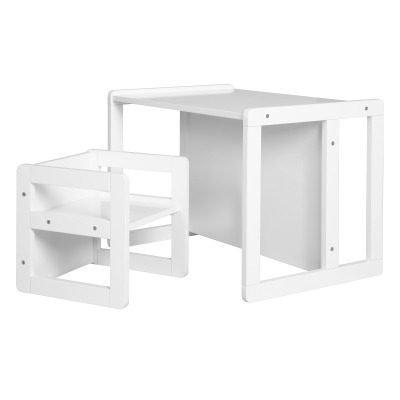
A lower and simpler set may suit a toddler, allowing the child to sit down independently. If its use changes or the child grows quickly, you could consider an adjustable solution. 3-in-1 furniture that can be used as a stool, chair, bench and table in different configurations is designed for more flexible use. With this kind of set, however, check which heights and uses are specified for the particular product rather than assuming all adjustable models are the same.
Consider the room and movement
In a small child's room, measuring the tabletop alone is not enough. Think about whether the chair can be pulled out from under the table, whether the child can reach the seat from both sides, and whether there is room around the table to stand up and move. A set with two chairs needs more space for use than a table on its own, but it may still take up less room than two separate tables.
Before buying, mark the approximate position of the table on the floor and leave room for the chairs to move. The tabletop size should suit the activity: a smaller surface may be enough for eating or looking at books, but extra space quickly becomes important for drawing and building with blocks. Storage helps keep the surface tidy, but boxes or baskets under the tabletop may reduce legroom. So always check both the overall dimensions and the internal layout.
Kids' Tables and Chairs
Kids' Tables and Chairs provide a practical activity space in a child's room, but sets can vary considerably. Some kids' table and chair sets are designed for simple meals and play, others are better suited to drawing, while some offer storage or a chalkboard surface. Before deciding based on appearance, check how many chairs are included, the size of the tabletop and whether the extra features take up work or legroom.
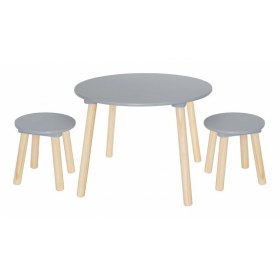
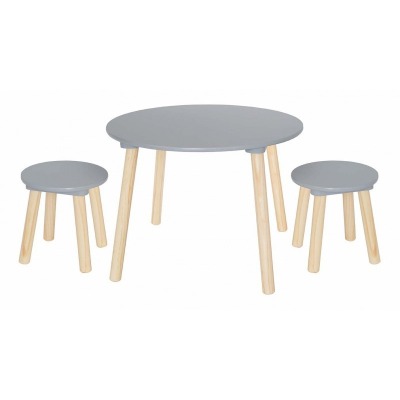
If you would like to create a little space of their own for your child, you could start with a simple table and chairs. For example, a set with a grey round table and two chairs has a tabletop with a diameter of 59 cm and chairs that are 26 cm high; the surface is described as easy to clean. These details show why it is important to compare the dimensions of the specific model before buying, rather than deciding based only on a general age recommendation.
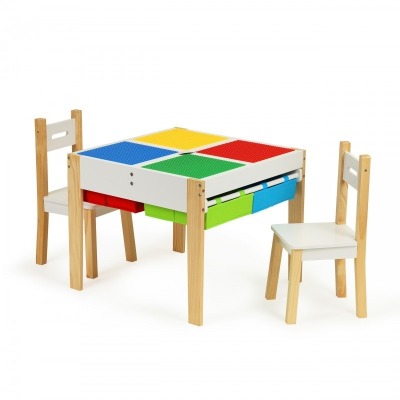
A set with two chairs can be a good solution for a family where two children use the table at the same time or where one seat is for a guest. However, two chairs do not automatically mean the tabletop is suitable for two longer craft sessions: check how much room there is for paper, blocks and hands. The wooden children's furniture set “table + 2 chairs Lego” adds four compartments under the tabletop for storing books and toys. Its tabletop consists of two removable sections: one is designed for building blocks, while the other provides a flat surface for drawing, painting and other creative activities.
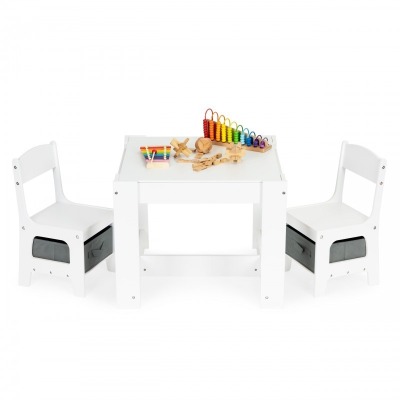
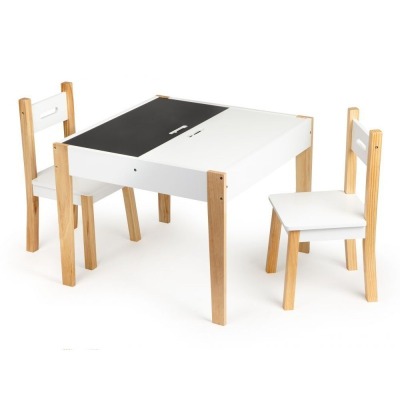
If your child's activities change often, a removable tabletop is practical only if it is convenient to change at home and the parts needed can be kept together. A chalkboard option may suit a young artist who will actually use the chalk surface. The wooden children's furniture set with chalkboard has two chairs, a removable double-sided tabletop, storage under the tabletop and seats, and a chalkboard. This differs considerably from a standard kids' table and 2-chair set, so be sure to check the product details for the extras.
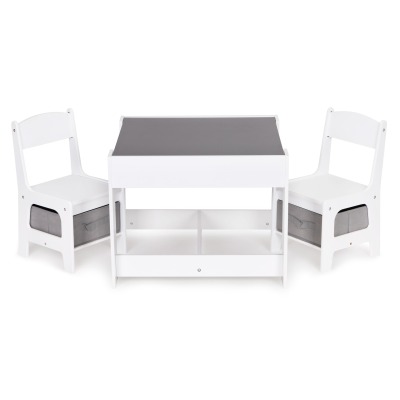
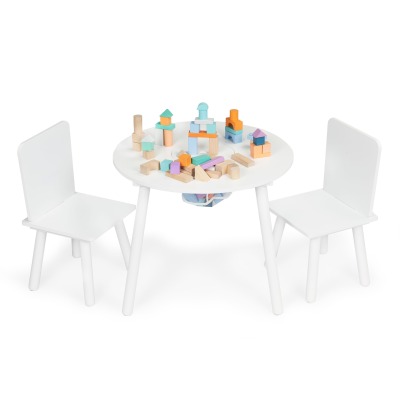
A simpler-looking set may suit a room where the furniture needs to blend in with the rest of the decor. The White Kids set has two chairs, a large round tabletop, pine legs and a mesh toy storage net under the tabletop. According to the description, it is suitable for learning, playing and independent eating, and the MDF surface is easy to care for.
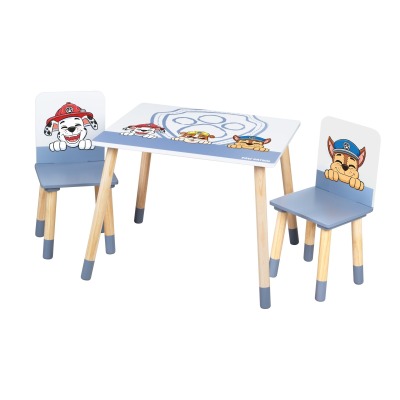
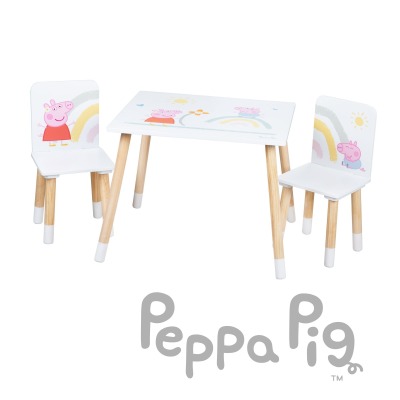
Another option is sets with designs familiar to children. The three-piece Paw Patrol set includes one table and two chairs, with pictures of Chase, Marshall and Rubble. According to the product description, it has rounded corners and edges, a skin-neutral and food-safe lacquer finish, and can be cleaned with a damp cloth. The Peppa Pig set also has two chairs and one table, decorated with Peppa and George motifs. It is described as combining solid wood and MDF, with rounded edges and a smooth surface that can be cleaned with a damp cloth, and as complying with the EN 71-1:2014 safety standard.
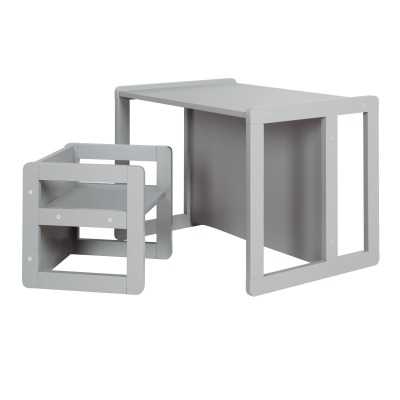
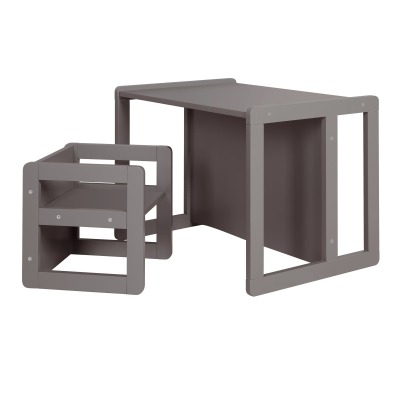
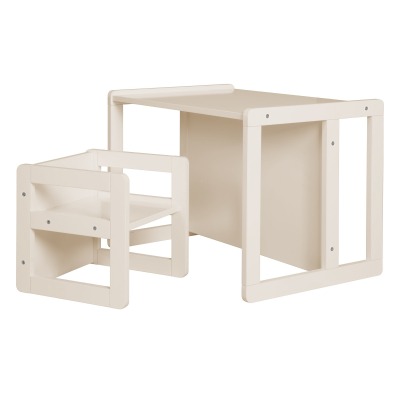
If your child is growing or you would like to use one piece of furniture in several ways, consider 3-in-1 options. The grey 3-in-1 set can be used as a convertible stool, chair, bench and table; the description states that it is suitable from 9 months. The stool has a load capacity of up to 60 kg and the chair up to 30 kg, while the bench supports up to 60 kg as a table and up to 40 kg as a bench. These figures apply to this specific model and are not a general recommendation for all kids' tables and chairs.
The anthracite-coloured version has a convertible stool with three height settings and a bench with two height settings. The cashmere-coloured model combines a stool, chair and bench and is described as suitable from 9 months of age. When choosing a colour, compare these models primarily by the space available and how they will be used; according to their descriptions, their main feature is versatile conversion, not simply a different shade.
Which kids’ table and chair set should you choose?
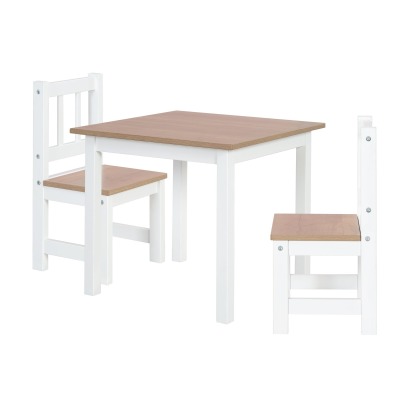
A standard table with two chairs is suitable for families who need a dedicated place for eating, playing, drawing or looking at books. Two separate chairs allow two children to sit side by side and can be moved away from the table independently when needed. The drawback is that a standard set may not provide storage, a blackboard or a growing seating solution.
A set with a storage compartment helps bring building blocks, books and other supplies closer to the activity area. At the same time, check whether the compartments, boxes or baskets under the seat leave enough room for the child’s legs.A set with a chalkboard is a good choice if your child enjoys writing or drawing with chalk and a removable or reversible tabletop does not make everyday use too complicated. A chalkboard can offer more activities, but whether it is needed depends on your child’s interests and the space available at home.
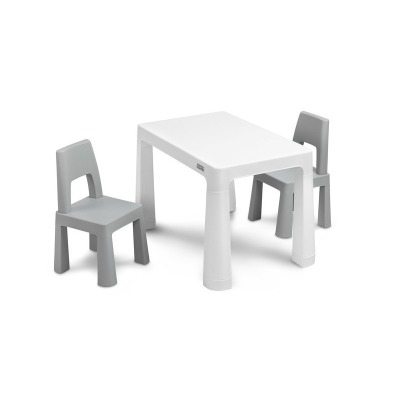
A 3-in-1 solution is more flexible, as the same furniture can be used as a stool, chair, bench or table. It may suit a growing child and a smaller room, but before buying, check all the possible configurations, weight capacity and the space needed to convert it. In terms of material, wood often has a homelier look, MDF allows for a range of finishes and shapes, and plastic can be lightweight and easy to move. No material is automatically best for every use: compare the surface, finish, construction and cleaning instructions of the specific model.
If you have two children, look beyond the number of chairs and consider the width of the tabletop and whether both children can use it at the same time without getting in each other’s way. Two separate chairs are often more flexible than a bench, but a bench may take up less space and offer a different seating option. If needed, also compare kids’ learning towers in the category if you are mainly looking for a way to support your child in another everyday activity, rather than for a table for independent play or crafts.
A practical pre-purchase check and planning for use
Before placing your order, run through a short checklist. Measure the space for the table and allow room to pull out the chairs and for your child to move around. Then check the product page for the table and chair dimensions, seat height, age or use restrictions, and the parts included in the set. Ask yourself whether it comes with one or two chairs, and whether it includes a bench, removable tabletop, blackboard, drawer, paper roll, storage box or another extra feature.
- Stability: check whether the table and chairs stand firmly and whether the construction is suitable for your child’s usual movements.
- Edges and corners: look for clearly described rounded edges, or check the product images and description to see how the edges are finished.
- Material and finish: distinguish between wood, MDF and plastic, and check the manufacturer’s cleaning and use instructions.
- Weight capacity: use only the figure given for the specific model; do not infer a category-wide limit from the information for one set.
- Assembly: check whether the furniture is delivered assembled or needs to be assembled at home, and whether all the necessary fixings are included.
Plan activities around the tabletop
For drawing and painting, your child needs a clear surface with room for paper and the supplies they are using. When playing with building blocks, storage can be just as important as the size of the tabletop, as the materials can be put away in nearby compartments when playtime is over. A calmer, tidier surface is often enough for looking at books, but allow more space if two children will use it at the same time.
Storage boxes, baskets under the seats, compartments and sections beneath the tabletop help keep the activity area tidy. In return, check whether your child’s legs and knees fit comfortably under the table. For a set with a blackboard, also measure the space needed to use the blackboard and consider where to keep the chalk or other accessories.
Care and everyday use
Wipe away food crumbs and craft residue as soon as possible. Clean with a damp cloth only if this is specified in the description or instructions for the particular product; for example, a smooth surface that can be cleaned with a damp cloth is specifically noted for the Paw Patrol and Peppa Pig sets. Care requirements may vary for MDF, melamine, wood and plastic, so do not assume that every surface can tolerate the same amount of moisture.
For 3-in-1 furniture, make sure the stool, bench or table is in the correct position before your child sits down. After reconfiguring the furniture, check that the parts are positioned according to the manufacturer’s instructions. It is also worth checking the joints and legs regularly, especially if the set is moved often.
Common mistakes when buying a kids’ table and chairs
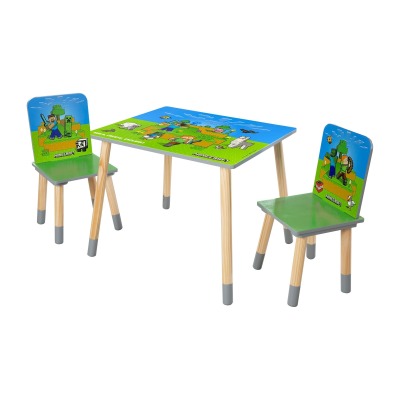
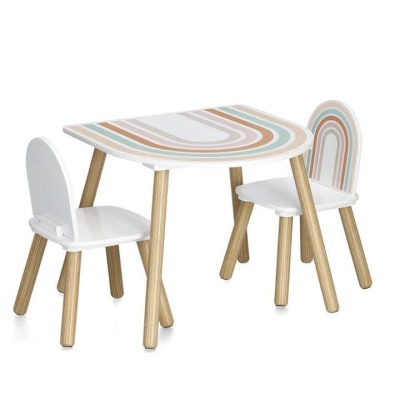
- Choosing only by colour or character design. Your child may like a pink motif, Rainbows or a Minecraft design, but these say nothing about whether the seat height or tabletop is suitable. The solution is to always check the measurements and intended use after considering the design.
- Assuming age determines the right height. Two-, three- and four-year-olds can vary in height. Use age only as a guide, and base your decision on your child’s measurements and sitting position, as well as the information on the product page.
- The contents of the set are not checked. “Table and chairs” does not always mean the same thing. Check whether it includes one or two chairs, and whether it comes with a chalkboard, removable tabletop, storage box, paper roll or bench.
- The table is placed in a space that is too cramped. If the chair cannot be pulled out far enough or the child cannot sit down comfortably, a good set may go unused in everyday life. Mark out the table’s position on the floor and allow room to move around it.
- Additional features are chosen out of habit. A chalkboard, drawer or storage space is useful only if the child uses it and it does not take up too much legroom. Think first about the activities that will actually take place at the table.
- The material leads to an overly general conclusion. Wood, MDF and plastic can all be suitable, but the result depends on the specific construction, surface and finish. Check the product details for the model rather than relying on the material name alone.
Also, don’t overlook the load capacity, age limit, edge design and assembly information given in the product details. These may vary from model to model, even when sets look similar.
Frequently asked questions
What age is a children’s table and chair set suitable for?
There is no single age limit that applies to all sets. Check the specific product description and compare it with your child’s height, the chair’s seat height and the table height. Some models are described as suitable from 9 months, while others are intended, for example, from 18 months.
How do you choose a table and chair height to suit your child’s height?
Check that your child can sit with their feet on the floor, their back against the backrest and their arms reaching the table without stretching too far or raising their shoulders. Measure the height from the floor to the seat and tabletop at home, then compare these measurements with the information in the product details.
How high should a children’s table be for a 2-, 3- or 4-year-old?
You cannot determine the exact height based on age, as children’s heights and proportions vary. The right choice depends on how your child sits and the measurements of the specific table and chair. If you cannot try them out, measure your child and check the measurements provided by the manufacturer.
Should you choose a wooden or MDF children’s table and chairs?
The choice of material depends on the specific construction, finish and care instructions. Wood can give furniture a natural look, MDF allows for different shapes and finishes, and plastic can be lightweight and easy to move. Always compare the information for the specific model, not just the material name.
Is a children’s table and chair set suitable for two children at the same time?
A set with two chairs may suit two children if there is enough table space for both and room to move around the chairs. Two chairs do not automatically guarantee comfortable shared crafting, so check the tabletop size and the type of activity.
Is a children’s table with a chalkboard practical?
A chalkboard can be useful if your child enjoys drawing or writing with chalk. Check whether the tabletop is removable, which part functions as a chalkboard and where the items needed to use it can be stored. Also bear in mind that a chalkboard design may require more space for tidying.
Should a table set have a drawer or storage box?
Storage space makes it easy to keep blocks, books and drawing supplies close at hand. However, compartments under the tabletop or baskets beneath the seat can reduce legroom. Choose a model with storage if its features support the way you will actually use it.
How do you check children’s furniture for safety and ease of cleaning?
Check the stability, edges, corners, load capacity and usage restrictions provided by the manufacturer. Follow the instructions for the specific model when cleaning; use a damp cloth only if the product description or care instructions allow it. Don’t assume that all wood, MDF or plastic surfaces can withstand the same cleaning products.
Summary
Choosing the right children’s table and chairs starts with your child’s measurements and how the set will be used, not just its appearance. Check three things: whether your child can sit with their feet supported and their back close to the backrest, whether the tabletop and space around the chairs are adequate, and whether the set’s actual contents meet your needs. Then compare whether a standard set with two chairs, a model with storage or a chalkboard, or a flexible 3-in-1 solution is right for your home.
Browse the children’s tables and chairs category and compare the measurements, materials, colour, number of chairs and additional features in the product details. This will help you find a solution that suits your child’s activities, room size and family’s daily routine, without having to decide based only on a picture or age recommendation.